Altitude and Hypoxia Training - a Short Review
Intermittent Hypoxic Training (IHT) involves brief periods of animate air that's modified to provide balmy controlled doses of hypoxic (oxygen reduced) air for the purpose of producing a range of beneficial physiological adaptations similar to those that can occur when humans adapt to high altitude environments.
Athletes make use of various loftier altitude training and living environments to better strength, speed and other aspects of performance (Gough, Saunders et al 2012). Over 80% of Olympic medal winners have made use of altitude training and both the Australian and NSW institutes of sport have altitude training chambers.
Not-athletes, including the elderly have too been shown to benefit with improvements in various markers of aerobic fitness, circulation and breathing (Burtscher, Pachinger et al 2004). Full general health tin likewise improve in non-athletes who spend time at altitude. The broad improvements in body function that have been reported from moderate and prolonged stays at distance propose better immune part, increased anti-oxidant production,enhanced metabolic part, improved glycemic control equally well every bit better claret menstruation and breathing (Singh 1977, Larsen, Hansen et al. 1997, Lee, Chen et al. 2003). Some conditions found to meliorate in high altitude environments include asthma, diabetes, depression, anxiety, gastrointestinal affliction and obesity (Singh 1977, Kayser and Verges 2013, Kong, Zang et al. 2014, Wang, Liu et al. 2014).
Decades of research in the onetime Soviet Union showed that IHT could attain the aforementioned benefits every bit sustained exposure to high altitude weather (Serebrovskaya 2002).
What's involved?
During IHT the person alternates breathing oxygen reduced air with room air or with oxygen enriched air, through intervals typically several minutes long. IHT breathing programs are individually selected for each individual in accord with their adaptive capacity, condition and grooming objectives.
A sample IHT plan can involve 10-30 sessions which involve breathing moderate hypoxia (ix–16% inspired O2) for 3-vii minutes alternate with normoxia or hyperoxia (21-35%O2) for almost iii-5 minutes for sixty minutes.
Hypoxic conditioning – Tool of adaptive medicine
Oxygen is the well-nigh essential chemical element for our survival, and the adverse consequences of hypoxia are well known, then its surprising to many to hear that controlled exposure to oxygen deficit (or hypoxia) if within a person's adaptive range, can actually promote longevity, enhance physical performance and even assist to create conditions that support healing in certain diseases (Serebrovskaya 2002, Verges, Chacaroun et al. 2015).
The reason this occurs is that brief, intermittent exposure to hypoxia stimulates a range of the body'south adaptive responses through epigenetic changes and increased expression of genes similar hypoxia inducible factor (HIF), uncoupling poly peptide 2 (UCP2) and methyl-tetrahydrofolate reductase (MTHFR) that are involved in angiogenesis, glycolysis, lactate shuttling, glucose transport, capillary density and mitochondrial function. Hypoxia has protective effects on the cell and on Dna considering information technology induces p53, a transcription regulation factor that is sometimes called the "guardian of the genome". It has a protective and repairing role in DNA damage.
The finish result of hypoxia adaptation is improved oxygen, improve circulation, improved mitochondrial office, increased tolerance to various stressors and even toxic chemicals, increased antioxidant production and reduced inflammation (Kayser and Verges 2013, Verges, Chacaroun et al. 2015). These adaptive changes enhance physical and mental capacity, so that the body is better able to cope with a range of stressors and repair and heal cells tissues and organs. The Russians have led the research in this field since the early 1960's and have been applying what they take found to medicine, sport and physical atmospheric condition (Serebrovskaya 2002). In contempo years research done in the Us, Europe and China has added to the body of knowledge on IHT and its clinical applications.
Cantankerous accommodation
Other far reaching effects on full general office of the organism occur because of the principle of "cantankerous accommodation' (Meerson 1993). Adaptation to one type of stress or load will, to some extent, increase the body'south ability to cope with stresses of another type. It is well known that a regular exercise programme is associated with an increased tolerant to stress. Stress-related diseases such as hypertension, heart disease, ulceration of the tum or duodenum, diabetes, dermatological diseases and matted immunity have all been shown to meliorate with both exercise and IHT. Protection comes because the body becomes more tolerant and resistant to stress. Dr. F.Z. Meerson, a primal researcher in the field of Adaptive Medicine, describes how a stressor can increment stress resilience:
- By inducing a fade abroad of the stress reaction
- By increasing action of the central and peripheral stress limiting systems
- Past desensitization of target organs.
Other key physiological mechanisms of IHT
Oxygen and claret menstruation- Hypoxia leads to the production of hypoxia-inducible-factor (HIF-1). This leads to production of vascular endothelial growth gene (VEGF) and stimulates EPO production.
Improvement in the blood oxygen transport capacity induces altitude acclimatisation (Rodriguez FA, Casas H et al. 1999, Casas, Casas et al. 2000, Costa, Alva et al. 2013). It is also associated with increased anaerobic threshold and blood lactate kinetics (Rodriguez FA, Casas H et al. 1999, Casas, Casas et al. 2000, Koistinen, Rusko et al. 2000, Lippi, Franchini et al. 2011)
Nitric Oxide-IHT increases endothelial production of nitric oxide (NO) which has the short term effect of increasing regional cerebral blood flow and augmenting the vaso- and neuroprotective effects of endothelial NO in conditions such a hypertension. All the same, the torso as well needs to be protected from excessive product of NO by microglyia, astrocytes and cortical neurons as this generates neurotoxic peroxynitrite. Controlled exposure to IHT which promotes adaptation to hypoxia prevents NO overproduction in the encephalon and other tissues, and enhances storage of excessive NO in the form of Due south-nitrosothiols and dinitrosyl iron complexes. The finish issue is neuro-protection of diverse pathologies, reduced blood force per unit area (Lyamina, Lyamina et al. 2011) and a reduction of oxidative stress (Malyshev, Bakhtinia et al. 2001, Manukhina, Downey et al. 2016).
Hypoxia and Stem Cells- Stem Cells by and large arise from our bone marrow and are involved in regenerating and repairing trunk tissues damaged from daily wear and tear. Stem cells are most abundant in fetal circulation where oxygen levels are very low. They disappear from circulation soon after birth merely survive in various hypoxic niches in adulthood. They human activity as a pool of undifferentiated cells that can be used to repair bone, cartilage, muscle, blood vessels, nerves and other body tissues. They can undergo trans-differentiation to other cell types, such as liver cells, neurons, cardiac myocytes and vascular endothelium.
The quantity of stem cells in peripheral blood fluctuates and diverse stressors including practice, inflammation and hypoxia tin can mobilise stem cells into circulation so that they can and then movement to areas where they exercise their regenerative work.
Stem cells are besides important in immune part, helping to prevent infections and tissue damage. Intermittent hypoxic training has been found to mobilise stem cells and amend immunity in adult men. A 2-week plan of 4 cycles of circadian, 5-min exposures to hypoxia altered stalk cell migration and increased circulating platelets, and augmented phagocytic and bactericidal activities of neutrophils, while suppressing pro-inflammatory cytokines (Serebrovskaya, Nikolsky et al. 2011) .
Illness conditions where the stimulating effects of intermittent hypoxia on stem cells can meliorate health include type 2 diabetes mellitus, coronary avenue disease, osteoarthritis, Parkinson's disease and chronic renal failure (Malshe 2011).
Hypoxia – a thing of dose
Intermittent hypoxia (IH) has been a subject of considerable investigation from the viewpoint of its agin and beneficial effects. Recent studies reveal that IH has varied effects on multiple torso systems and that the magnitude of these furnishings (and even the direction) depends on the IH "dose". With low cycles-per-24-hour interval counts and/or mild to moderate hypoxic episodes benign effects are predominant (Navarrete-Opazo and Mitchell 2014, Verges, Chacaroun et al. 2015). Depression doses of IH in the body's adaptive range tin accept a direct opposite effect to those demonstrated in patients with slumber apnea, respiratory insufficiency, stroke or infarct (Serebrovskaya, Manukhina et al. 2008, Burtscher, Haider et al. 2009). Notably there have been no reported cases of adverse events from clinical use of IHT in the scientific literature (Rosalba Courtney 2015-unpublished literature review).
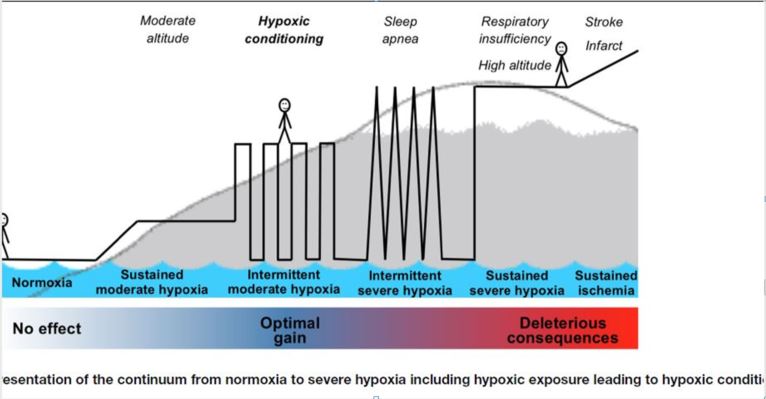
Image from From Verges- 2015 Frontiers in Pediatrics- "Hypoxic Conditioning equally a New Therapeutic Modality".(Verges, Chacaroun et al. 2015)
Literature on specific conditions and IHT
(English linguistic communication research and reviews merely)
| Respiratory – Improve COPD/bronchial asthma clinical symptoms without unwanted side effects.Review showing treatment of asthma and COPD to be one of the most studied applications of IHT, Over 20 years of clinical usage and research in Russia and Ukraine showing no adverse effects and consistent improvement. | (Serebrovskaya, Swanson et al. 2003) |
| Respiratory – Beneficial furnishings in mild COPD patients, including increased exercise tolerance, improved autonomic nervous system role, improved lung office (hypercapnic ventilatory response, forced expiratory book in 1s, and forced vital capacity). | (Haider, Casucci et al. 2009, Burtscher, Gatterer et al. 2010) |
| Respiratory – Amend respiratory (and nonrespiratory) motor output after spinal cord injury and in amyotropic lateral sclerosis (ALS). | (Mitchell 2007) |
| Immune – Raise the innate immune arrangement (e.g. increment neutrophils' phagocytic and bactericidal activities) while having an overall anti-inflammatory effect (suppressing pro-inflammatory mediators by more than than ninety%) in healthy humans. | (Serebrovskaya Television, Nikolsky IS et al. 2011) |
| Cardiovascular – Decrease systolic pressure by up to 30 mmHg and diastolic force per unit area by upwards to 15 mmHg in in individuals with hypertension. | (Serebrovskaya, Manukhina et al. 2008) |
| Cardiovascular – Increased nitric oxide synthesis and decreased BP to values similar to those of normotensive individuals. Blood pressure reduction persisted for at least 3 months in 28 of 33 hypertensive subjects. | (Lyamina, Lyamina et al. 2011) |
| Cardiovascular – Protective confronting myocardial injuries and attenuate confronting subsequent ischemic incidence. Review by Zhuang discusses variety of protective furnishings including neurohumoral alterations. Clinical protocols of IHT tin avoid agin furnishings caused by high dose IH and chronic continuous hypoxia. | (Zhuang J and Z. 1999, Dirnagl, Becker et al. 2009) |
| Neuromuscular – Therapeutic benefits post-obit cervical spinal injury and improved motor output. | (Mitchell 2007, Tester, Fuller et al. 2014) |
| Neuromuscular – Comeback in limb function in motor incomplete, chronic (<1 year) SCI patients (American SCI Clan Impairment Scale C or D). | (Trumbower, Jayaraman et al. 2012) |
| Neuromuscular – Increase walking speed (10-k walk exam) and distance in SCI patients past upward to eighteen% iii days later on handling. | (Hayes, Jayaraman et al. 2014) |
| Brain and Nervous Organization – Hypoxic preconditioning at adapative dose can stimulates neurogenesis, it increases resistance to effect of toxic chemic substances and is protective against cerebral ischemia from various causes (Basovich 2013). | (Basovich 2013) |
| Brain and Nervous System – Protect cerebrovascular part in Alzheimers disease, an important modifiable take a chance factor for Alzheimer'southward disease. Treatment of experimental models of AD showed that intermittent hypoxic grooming (IHT) improved the wellness of both cognitive and extra-cerebral claret vessels, prevented the loss of neurons in the cortex and improved memory. Beneficial furnishings of IHT has also been shown for other neuropathologies including dyscirculatory encephalopathy, ischemic stroke injury, audiogenic epilepsy, spinal cord injury, and alcohol withdrawal. | (Manukhina, Downey et al. 2016) |
| Encephalon and Nervous System – Attenuate the response to subsequent ischemic incidents, preconditioning the brain and promoting endogenous mechanisms for recovery of noxious stimuli and recovery from damage. | (Dirnagl, Becker et al. 2009) |
| Brain and Nervous System – No detrimental changes afterwards IHT in spasticity, middle rate or cognitive function, in spinal cord injury patients post-obit IHT. | (Hayes, Jayaraman et al. 2014) |
| Brain and Nervous System – Raise exercise's positive furnishings on sleep quality & cognitive function in the elderly. | (Schega, Peter et al. 2013) |
| Brain and Nervous System – No detrimental effect afterward IHT on alertness, vigilance, or working memory in young healthy adults. | (Rodriguez FA, Casas H, Casas Thou, Pages T, Rama R, Ricart A, Ventura JL, Ibanez J and V. G. 1999) |
| Brain and Nervous Organisation – No detrimental effect on measures of cognitive role. | (Ando S, Hatamoto Y et al. 2013, Schega, Peter et al. 2013) |
| Metabolism – Beneficial effects on metabolism, including reduced body weight, cholesterol, and claret saccharide levels, equally well as increased insulin sensitivity. | (Netzer, Chytra et al. 2008, Mackenzie, Maxwell et al. 2011, Urdampilleta, Gonzalez-Muniesa et al. 2012, Fuller and Courtney 2016) |
| Metabolism – Improvements in metabolic markers are accompanied by improved cardiorespiratory function and improved exercise capacity. | (Shi, Watanabe et al. 2013) |
| Metabolism – A benign issue of moderate controlled hypoxia has been shown for a number of metabolic parameters associated with obesity including improved insulin sensitivity and glucose tolerance, and decreased cholesterol levels (Haufe, Wiesner et al. 2008) [6,vii]. | (Haufe, Wiesner et al. 2008) |
| Sleep Apnoea – Improved neuroplasticity of breathing command that in presence of normal CO2 mitigates sleep apnoea. | (Mateika and Syed 2013) |
| Slumber Apnoea – While obstructive sleep apnoea oft leads to persistent, maladaptive chemoreflex-mediated activation of the sympathetic nervous system which culminates in hypertension, controlled IHT conditioning programs tin can be safe, efficacious modalities for prevention and treatment of hypertension. This commodity reviews outcomes of Soviet research and describes enquiry on mechanisms. | (Serebrovskaya, Manukhina et al. 2008) |
| Oxygen – Improved blood oxygen ship chapters. | (Rodriguez FA, Casas H et al. 1999, Casas, Casas et al. 2000, Koistinen, Rusko et al. 2000, Lippi, Franchini et al. 2011) |
| Oxygen – Induced altitude acclimatisation. | (Casas, Casas et al. 2000, Billaut, Gore et al. 2012, Costa, Alva et al. 2013) |
| Physical Performance – Increase aerobic capacity/endurance/athletic performance. | (Rodriguez FA, Casas H et al. 1999, Casas, Casas et al. 2000, Costa, Alva et al. 2013) |
| Concrete Performance – Induce a range of physiological adaptations that enhance fettle and athletic performance. | (Burtscher, Pachinger O et al. 2004) (Bonetti and Hopkins 2009, Lippi, Franchini et al. 2011)(Bazzani 2007) |
| Physical Performance – Improved energy efficiency, do capacity and diverse measures of performance. | (Czuba, Waskiewicz et al. 2011, Czuba, Zając et al. 2013, Czuba, Maszczyk et al. 2014) |
| Physical Operation – Age related – Fitness improvements can be greater in untrained older individuals with greater positive effects on hemodynamics, microvascular endothelial function, and work capacity. | (Shatilo, Korkushko et al. 2008). |
| Concrete Performance – Age related – Increase peak oxygen consumption and diminish heart rate, systolic blood force per unit area, blood lactate concentration and perceived exertion during submaximal do in 50–70 YO men. Changes in responses to exercise later on IH were similar in subjects with and without prior myocardial infarction. | (Burtscher, Pachinger O et al. 2004). |
For an assessment or to volume an IHT course contact Rosalba hither
REFERENCES
Ando Southward, Hatamoto Y, Sudo M, Kiyonaga A, Tanaka H and H. Y (2013). "The effects of practise under hypoxia on cognitive function." PLoS I 8 e63630, .
Basovich, S. N. (2013). "Trends in the use of preconditioning to hypoxia for early prevention of future life diseases." Biosci Trends 7(1): 23-32.
Bazzani, C., Ed. (2007). Enhancing Therapeutic Compliance. Fundamentals of Sleep Technology, Lippincott Williams & Wilkins.
Billaut, F., C. J. Gore and R. J. Aughey (2012). "Enhancing Team-Sport Athlete Functioning." Sports Medicine 42(9): 751-767.
Bonetti, D. L. and W. G. Hopkins (2009). "Sea-Level Practice Performance Following Adaptation to Hypoxia: A Meta-Analysis." Sports Medicine 39(two): 107-127.
Burtscher, M., H. Gatterer, C. Szubski, E. Pierantozzi and M. Faulhaber (2010). "Effects of interval hypoxia on exercise tolerance: special focus on patients with CAD or COPD." Slumber and Animate 14(3): 209-220.
Burtscher, M., T. Haider, Due west. Domej, T. Linser, H. Gatterer, M. Faulhaber, E. Pocecco, I. Ehrenburg, E. Tkatchuk, R. Koch and L. Bernardi (2009). "Intermittent hypoxia increases exercise tolerance in patients at take a chance for or with mild COPD." Respir Physiol Neurobiol 165(1): 97-103.
Burtscher, M., Pachinger O, I. Ehrenbourg, One thousand. Mitterbauer, Thou. Faulhaber, R. Puhringer and Eastward. Tkatchouk (2004). "Intermittent hypoxia increases practise tolerance in elderly men with and without coronary artery disease." Int J Cardiol 96: 247-254.
Casas, M., H. Casas, T. Pages, R. Rama, A. Ricart, J. L. Ventura, J. Ibanez, F. A. Rodriguez and G. Viscor (2000). "Intermittent hypobaric hypoxia induces altitude acclimation and improves the lactate threshold." Aviat Space Environ Med 71: 125-130.
Costa, D. C., Northward. Alva, L. Trigueros, A. Gamez, T. Carbonell and R. Rama (2013). "Intermittent Hypobaric Hypoxia Induces Neuroprotection in Kainate-Induced Oxidative Stress in Rats." Journal of Molecular Neuroscience 50(3): 402-410.
Czuba, Thou., A. Maszczyk, D. Gerasimuk, R. Roczniok, O. Fidos-Czuba, A. Zajac, A. Golas, A. Mostowik and J. Langfort (2014). "The effects of hypobaric hypoxia on erythropoiesis, maximal oxygen uptake and free energy cost of practice nether normoxia in elite biathletes." J Sports Sci Med 13(four): 912-920.
Czuba, Thousand., Z. Waskiewicz, A. Zajac, S. Poprzecki, J. Cholewa and R. Roczniok (2011). "The effects of intermittent hypoxic training on aerobic capacity and endurance performance in cyclists." Journal Of Sports Science & Medicine 10(1): 175-183.
Czuba, M., A. Zając, A. Maszczyk, R. Roczniok, S. Poprzecki, West. Garbaciak and T. Zając (2013). "The Furnishings of Loftier Intensity Interval Grooming in Normobaric Hypoxia on Aerobic Capacity in Basketball Players." Periodical of Human Kinetics 39: 103-114.
Dirnagl, U., K. Becker and A. Meisel (2009). "Preconditioning and tolerance against cerebral ischaemia: from experimental strategies to clinical utilize. ." Lancet Neurol 8: 398-412.
Fuller, Due north. R. and R. Courtney (2016). "A instance of remission from pre-diabetes following intermittent hypoxic preparation." Obesity Inquiry & Clinical Practise In Press.
Gough, C. Eastward., P. U. Saunders, J. Fowlie, B. Cruel, D. B. Pyne, J. Grand. Anson, North. Wachsmuth, N. Prommer and C. J. Gore (2012). "Influence of altitude training modality on operation and total haemoglobin mass in elite swimmers." European Journal of Applied Physiology 112(nine): 3275-3285.
Haider, T., G. Casucci, T. Linser, M. Faulhaber, H. Gatterer, G. Ott, A. Linser, I. Ehrenbourg, East. Tkatchouk, M. Burtscher and L. Bernardi (2009). "Interval hypoxic preparation improves autonomic cardiovascular and respiratory command in patients with balmy chronic obstructive pulmonary disease." J Hypertens 27(eight): 1648-1654.
Haufe, S., S. Wiesner, South. Engeli, F. C. Luft and J. Jordan (2008). "Influences of normobaric hypoxia training on metabolic risk markers in human subjects." Med Sci Sports Exerc 40(11): 1939-1944.
Hayes, H. B., A. Jayaraman, M. Herrmann, G. Due south. Mitchell, Due west. Z. Rymer and R. D. Trumbower (2014). "Daily intermittent hypoxia enhances walking later on chronic spinal cord injury." Neurology 82: 104-113.
Kayser, B. and S. Verges (2013). "Hypoxia, free energy balance and obesity: from pathophysiological mechanisms to new treatment strategies." Obes Rev 14(7): 579-592.
Koistinen, P. O., H. Rusko, K. Irjala, A. Rajamaki, K. Penttinen, 5. Sarparanta, J. Karpakka and J. Leppaluoto (2000). "EPO, crimson cells, and serum transferrin receptor in continuous and intermittent hypoxia. ." Med Sci Sports Exerc 32: 800-804.
Kong, Z., Y. Zang and Y. Hu (2014). "Normobaric hypoxia training causes more weight loss than normoxia training after a iv-week residential camp for obese young adults." Sleep Breath 18(3): 591-597.
Larsen, J. J., J. M. Hansen, North. V. Olsen, H. Galbo and F. Dela (1997). "The effect of altitude hypoxia on glucose homeostasis in men." J Physiol 504 ( Pt 1): 241-249.
Lee, Due west. C., J. J. Chen, H. Y. Ho, C. W. Hou, M. P. Liang, Y. W. Shen and C. H. Kuo (2003). "Brusque-term distance mountain living improves glycemic control." High Alt Med Biol 4(1): 81-91.
Lippi, Thou., M. Franchini and G. Banfi (2011). "Normobaric hypoxia and sports: the fence continues." European Journal of Applied Physiology 111(1): 159-160.
Lyamina, N. P., S. Five. Lyamina, 5. N. Senchiknin , R. T. Mallet, H. F. Downey and E. B. Manukhina (2011). "Normobaric hypoxia conditioning reduces blood force per unit area and normalizes nitric oxide synthesis in patients with arterial hypertension. ." J Hypertens 29 29: 2265-2272.
Mackenzie, R., North. Maxwell, P. Castle, G. Brickley and P. Watt (2011). "Acute hypoxia and exercise improve insulin sensitivity (S(I) (ii*)) in individuals with type two diabetes." Diabetes Metab Res Rev 27(one): 94-101.
Malshe, P. C. (2011). "Nisshesha rechaka pranayama offers benefits through brief intermittent hypoxia." Ayu 32(4): 451-457.
Malyshev, I. Y., 50. Y. Bakhtinia, T. A. Zenina, V. D. Mikoyan, L. N. Kubrina, A. F. Vanin and E. B. Manukhina (2001). "Nitric Oxide (NO) dependant mechanisms of adaptation to hypoxia." Hypoxia Medical Journal iii(ane): 23.
Manukhina, E. B., H. F. Downey, X. Shi and R. T. Mallet (2016). "Intermittent hypoxia training protects cerebrovascular function in Alzheimer's disease." Exp Biol Med (Maywood) 241(12): 1351-1363.
Mateika, J. H. and Z. Syed (2013). "Intermittent hypoxia, respiratory plasticity and sleep apnea in humans: present knowledge and future investigations." Respir Physiol Neurobiol 188(3): 289-300.
Meerson, F. (1993). Essentials of adaptive medicine: Protective effects of adaptation. Geneva, Hypoxia Medical.
Mitchell, A. (2007). Respiratory plasticity following intermittent hypoxia: a guide for novel therapeutic approaches to ventilatory command disorders. Genetic Basis for Respiratory Control Disorders. C. Gaultier. New York, Springer: 291-311.
Navarrete-Opazo, A. and 1000. S. Mitchell (2014). "Therapeutic potential of intermittent hypoxia: a matter of dose." Am J Physiol Regul Integr Comp Physiol 307(x): R1181-1197.
Netzer, Due north. C., R. Chytra and T. Kupper (2008). "Low intense concrete practice in normobaric hypoxia leads to more weight loss in obese people than low intense physical do in normobaric sham hypoxia." Slumber Jiff 12(2): 129-134.
Rodriguez FA, Casas H, Casas M, Pages T, Rama R, Ricart A, Ventura JL, Ibanez J and V. G. (1999). "Intermittent hypobaric hypoxia stimulates erythropoiesis and improves aerobic capacity." Med Sci Sports Exerc 31: 264-268.
Schega, L., B. Peter, A. Törpel, H. Mutschler, B. Isermann and D. Hamacher (2013). "Furnishings of intermittent hypoxia on cognitive operation and quality of life in elderly adults: a airplane pilot study." Gerontology 59(four): 316-323.
Serebrovskaya, T. V. (2002). "Intermittent hypoxia enquiry in the former Soviet Matrimony and the Commonwealth of Independent States: History and review of the concept and selected applications." High Altitude Medicine and Biology 3(2): 205-221.
Serebrovskaya, T. V. (2002). "Intermittent hypoxia enquiry in the former soviet union and the democracy of independent States: history and review of the concept and selected applications." High Altitude Medicine & Biology iii(2): 205-221.
Serebrovskaya TV, Nikolsky IS, Nikolska VV, Mallet RT and I. VA. (2011). "Intermittent hypoxia mobilizes hematopoietic progenitors and augments cellular and humoral elements of innate immunity in adult men." High Alt Med Biol 12: 243-252.
Serebrovskaya, T. V., B. Manukhina, M. 50. Smith, H. Downey and R. T. Mallet (2008). "Intermittent hypoxia: cause of or therapy for systemic hypertension? ." Exp Biol Med Maywood 233: 627-650.
Serebrovskaya, T. V., I. Due south. Nikolsky, V. V. Nikolska, R. T. Mallet and V. A. Ishchuk (2011). "Intermittent hypoxia mobilizes hematopoietic progenitors and augments cellular and humoral elements of innate immunity in developed men." High altitude medicine & biological science 12(3): 243-252.
Serebrovskaya, T. V., R. J. Swanson and E. E. Kolesnikova (2003). "Intermittent hypoxia: mechanisms of activity and some applications to bronchial asthma treatment." Periodical Of Physiology And Pharmacology: An Official Journal Of The Polish Physiological Society 54 Suppl 1: 35-41.
Shatilo, V. B., O. Five. Korkushko, V. A. Ischuk, H. F. Downey and T. V. Serebrovskaya (2008). "Effects of intermittent hypoxia training on exercise performance, hemodynamics, and ventilation in healthy senior men." Loftier Alt Med Biol 9: 43-52.
Shi, B., T. Watanabe, S. Shin, T. Yabumoto and T. Matsuoka (2013). "Upshot of normobaric hypoxia on cardiorespiratory and metabolic risk markers in healthy subjects." Advances in Bioscience and Biotechnology 4(three): 340-345.
Singh, I., Chohan, I.S., Lal, Grand., Khanna, P.K., Srivastava, M.C., Nanda, R.B., Lamba, J.S., Malhotra, M.Southward. (1977). "Furnishings of high altitude stay on the incidence of mutual diseases in man." Int. J. Biometeor 21(ii): 93-122.
Tester, N. J., D. D. Fuller, J. South. Fromm, M. R. Spiess, A. L. Behrman and J. H. Mateika (2014). "Long-term facilitation of ventilation in humans with chronic spinal string injury." Am J Respir Crit Care Med 189: 57-65.
Trumbower, R. D., A. Jayaraman, Chiliad. S. Mitchell and Due west. Z. Rymer (2012). "Exposure to acute intermittent hypoxia augments somatic motor function in humans with incomplete spinal string injury." Neurorehabil Neural Repair 26: 163-172.
Urdampilleta, A., P. Gonzalez-Muniesa, M. P. Portillo and J. A. Martinez (2012). "Usefulness of combining intermittent hypoxia and concrete do in the treatment of obesity." J Physiol Biochem 68(2): 289-304.
Verges, Southward., S. Chacaroun, D. Godin-Ribuot and Due south. Baillieul (2015). "Hypoxic Conditioning equally a New Therapeutic Modality." Front Pediatr 3: 58.
Wang, R., D. Liu, X. Wang, W. Xiao, Due north. Wu, B. Gao and P. Chen (2014). "The effect of 'sleep high and train low' on weight loss in overweight Chinese adolescents: study protocol for a randomized controlled trial." Trials 15: 250.
Zhuang J and Z. Z. (1999). "Protective effects of intermittent hypoxic adaptation on myocardium and its mechanisms. ." Biol Signals Recept eight: 316-322.
Source: https://www.rosalbacourtney.com/intermittent-hypoxic-training-altitude-training-at-sea-level/
0 Response to "Altitude and Hypoxia Training - a Short Review"
Post a Comment