Dark Film Mysteries Ii Film Noir Collectors Set Review
 Film Noir (literally 'black moving-picture show" or "black movie theatre') was coined by French moving-picture show critics (showtime by Nino Frank in 1946) who noticed the trend of how 'dark', downbeat and black the looks and themes were of many American crime and detective films released in France to theatres during and following World War II, such equally The Maltese Falcon (1941), Murder, My Sweet (1944), Double Indemnity (1944), The Woman in the Window (1944), and Laura (1944). A broad range of films reflected the resultant tensions and insecurities of the fourth dimension period, and counter-counterbalanced the optimism of Hollywood'south musicals and comedies.
Feelings of fear, mistrust, bleakness, loss of innocence, despair and paranoia (displayed through visual styling and low-key lighting) were readily axiomatic in noir, reflecting the 'chilly' Common cold State of war period when the threat of nuclear annihilation was always-present. The criminal, fierce, misogynistic, difficult-boiled, or greedy perspectives of anti-heroes in motion-picture show noir's story conventions were a metaphoric symptom of society'due south evils, with a strong undercurrent of moral conflict, purposelessness and sense of injustice. In that location were rarely happy or optimistic endings in noirs. The restrictive Production Code (or 'Hays Lawmaking') at the time dictated how subjects such as crime and sex could be handled, and promoted more suggestive plots with shadowy and nighttime elements.
Classic film noir developed during and after World War II, taking advantage of the post-war ambience of feet, cynicism, and suspicion. It was a mode of low-cost, B-list American films (the bottom of a double feature) that capitalized on advancements in film-making in the 20s and 30s, including synchronized sound, panchromatic (black and white) film stock with better light sensitivity, more compact lighting equipment, and cheaper on-location shoots.
Pic noir showtime evolved in the 1940s, became prominent in the post-state of war era, and lasted in a classic "Golden Historic period" period until about 1960 (marked by the 'last' film of the archetype film noir era, Orson Welles' Touch of Evil (1958)).
Important Note: Strictly speaking, motion-picture show noir is not a genre, but rather the mood, style, betoken-of-view, or tone of a moving picture. It is also helpful to realize that 'film noir' unremarkably refers to a distinct historical menstruum of film history - the decade of film-making afterwards World War Ii, similar to the German Expressionism or the French New Wave periods. However, information technology was labeled equally such only after the classic flow - early on noir film-makers didn't even use the film designation (as they would the labels "western" or "musical"), and were not conscious that their films would exist labeled noirs.
Very ofttimes, a film noir story was adult effectually a cynical, hard-hearted, disillusioned male character [e.thousand., Robert Mitchum, Fred MacMurray, or Humphrey Bogart], stereotypically a fedora-wearing gumshoe detective, who encountered a cute but promiscuous, amoral, double-dealing and seductive femme fatale [east.g., Mary Astor, Veronica Lake, Jane Greer, Barbara Stanwyck, or Lana Turner] in an urban setting. The 'killer dame' would often use her feminine wiles and come-hither sexuality to manipulate him into becoming the fall guy - oft following a murder. After a betrayal or double-cross, she was frequently destroyed as well, ofttimes at the cost of the hero's life. As women during the war flow were given new-found independence and better job-earning ability in the homeland during the state of war, they would suffer -- on the screen -- in these films of the 40s.
See this site's special tribute to
Greatest Femmes Fatales in Classic Film Noir
Titles of many film noirs often reflected the nature or tone of the style and content itself: Dark Passage (1947), The Naked City (1948), Fear in the Nighttime (1947), Out of the By (1947), Kiss Me Deadly (1955), etc.
Primary Characteristics and Conventions of Film Noir: Themes and Styles
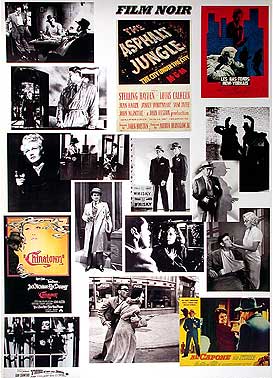 The primary moods of classic film noir were melancholy, alienation, bleakness, disillusionment, disenchantment, cynicism, ambiguity, moral corruption, evil, guilt, agony and paranoia. Those moods were oft derived from the plots of cheap, pulp fiction crime novels.
Heroes (or anti-heroes), corrupt characters and villains included downwardly-and-out, conflicted hard-boiled detectives or private eyes, cops, gangsters, government agents, a lone wolf, socio-paths or killers, crooks, war veterans, politicians, picayune criminals, murderers, or just plain Joes. These protagonists were often morally-ambiguous low-lifes from the dark and gloomy underworld of violent crime and corruption. Distinctively, they were cynical, tarnished, obsessive (sexual or otherwise), brooding, menacing, sinister, sardonic, disillusioned, frightened and insecure loners (usually men), struggling to survive - and in the cease, ultimately losing.
Storylines were often elliptical, non-linear and twisting. Narratives were frequently complex, maze-like and convoluted, and typically told with foreboding background music, flashbacks (or a series of flashbacks), witty, razor-abrupt and acerbic dialogue, and/or reflective and confessional, kickoff-person vocalisation-over narration. Amnesia suffered by the protagonist was a common plot device, as was the downfall of an innocent Everyman who cruel victim to temptation or was framed. Revelations regarding the hero were made to explicate or justify the hero'southward own cynical perspective on life.
Film noir films (mostly shot in gloomy grays, blacks and whites) thematically showed the night and inhumane side of human being nature with cynicism and doomed love, and they emphasized the brutal, unhealthy, nihilistic, seamy, shadowy, nighttime and sadistic sides of the human experience. An oppressive temper of menace, cynicism, anxiety, suspicion that anything tin can become wrong, dingy realism, futility, fatalism, defeat and entrapment were stylized characteristics of moving-picture show noir. The protagonists in movie noir were unremarkably driven by their past or by human weakness to echo former mistakes.
Film noir films were marked visually past expressionistic lighting, deep-focus or depth of field photographic camera work, disorienting visual schemes, jarring editing or juxtaposition of elements, ominous shadows, skewed camera angles (usually vertical or diagonal rather than horizontal), circumvoluted cigarette smoke, existential sensibilities, and unbalanced or moody compositions. Settings were ofttimes interiors with depression-primal (or unmarried-source) lighting, venetian-blinded windows and rooms, and dark, claustrophobic, gloomy appearances. Exteriors were ofttimes urban night scenes with deep shadows, wet asphalt, dark alleyways, rain-slicked or hateful streets, flashing neon lights, and depression key lighting. Story locations were often in murky and dark streets, dimly-lit and low-rent apartments and hotel rooms of big cities, or abandoned warehouses. [Often-times, war-time scarcities were the reason for the reduced budgets and shadowy, stark sets of B-pictures and pic noirs.]
Some of the most prominent directors of film noir included Orson Welles, John Huston, Billy Wilder, Edgar Ulmer, Douglas Sirk, Robert Siodmak, Fritz Lang, Otto Preminger, Henry Hathaway and Howard Hawks.
Femmes Fatales in Moving-picture show Noir:
The females in film noir were either of two types (or archetypes) - dutiful, reliable, trustworthy and loving women; or femmes fatales - mysterious, duplicitous, double-crossing, gorgeous, unloving, predatory, tough-sweet, unreliable, irresponsible, manipulative and desperate women. Usually, the male person protagonist in film noir wished to elude his mysterious past, and had to choose what path to have (or accept the fateful option made for him).
Invariably, the choice would be an overly ambitious one, to follow the dangerous but desirable wishes of these dames. It would be to pursue the goadings of a traitorous, self-destructive femme fatale who would atomic number 82 the struggling, disillusioned, and doomed hero into committing murder or some other criminal offence of passion coupled with twisted beloved. When the major character was a detective or individual eye, he would become embroiled and trapped in an increasingly-complex, convoluted case that would lead to fatalistic, suffocating evidences of corruption, irresistible beloved and decease. The femme fatale, who had likewise transgressed societal norms with her independent and smart, menacing actions, would bring both of them to a downfall.
Cinematic Origins and Roots of Classic Film Noir:
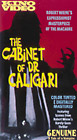 The themes of noir, derived from sources in Europe, were imported to Hollywood by emigre moving picture-makers. Noirs were rooted in German Expressionism of the 1920s and 1930s, such equally in The Cabinet of Dr. Caligari (1920, Germ.) or Fritz Lang's Metropolis (1927, Germ.), M (1931, Germ.), Fury (1936) and You Only Alive Once (1937). Films from High german directors, such as F. West. Murnau, Thou. W. Pabst, and Robert Wiene, were noted for their stark camera angles and movements, chiaroscuro lighting and shadowy, high-contrast images - all elements of later film noir. In addition, the French sound films of the 30s, such as manager Julien Duvivier'due south Pepe Le Moko (1937), contributed to noir's evolution.
Another cinematic origin of film noir was from the plots and themes oftentimes taken from adaptations of American literary works - usually from best-selling, hard-boiled, lurid novels and crime fiction by Raymond Chandler, James G. Cain, Dashiell Hammett, or Cornell Woolrich. As a result, the earliest movie noirs were detective or criminal offence thrillers. Film noir was besides derived from the crime/gangster and detective/mystery sagas from the 1930s (i.eastward., Little Caesar (1930), Public Enemy (1931) and Scarface (1932)), but very unlike in tone and characterization. Notable moving picture noir gangster films, such every bit They Drive By Nighttime (1940), Fundamental Largo (1948) and White Estrus (1949) each featured noir elements inside the traditional gangster framework.
The Primeval Film Noirs: In the 1940s
Many sources have claimed that director Boris Ingster's and RKO'south B-movie Stranger on the Third Floor (1940) was the first full-featured film noir. The expressionistic motion picture starred Peter Lorre as the sinister, odd-looking 'stranger' (bandage due to his creepy operation in M (1931)), in a story about the nightmarish after-effects for news reporter Michael Ward (John McGuire) whose court circumstantial testimony during a murder trial was used to captive murder suspect Joe Briggs (Elisha Cook Jr.). Afterwards, he was haunted (in a stunning dream sequence) by doubts that his primal testimony was inaccurate. Others merits Orson Welles' masterpiece Citizen Kane (1941) was besides an early and influential pre-motion picture noir.
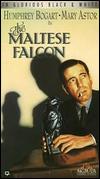 The first detective film to use the shadowy, nihilistic noir style in a definitive style was the privotal work of novice director John Huston in the mystery classic The Maltese Falcon (1941), from a 1929 volume by Dashiell Hammett. [Really, Huston'southward flick was not the kickoff version - it had been directed earlier by Roy Del Ruth in 1931, starring Ricardo Cortez in the lead part.] Information technology was famous for Humphrey Bogart's absurd, breviloquent private eye hero Sam Spade in pursuit of crooks greedy for a jewel-encrusted statue, and Bogart's foil - Mary Astor equally the deceptive femme fatale.
Noir Duo: Alan Ladd and Veronica Lake
 The acting duo of Alan Ladd and Veronica Lake was outset teamed in the superb early noir thriller This Gun For Rent (1942) (with the tagline: "He'south dynamite with a gun or a daughter"). From the novel A Gun For Sale by renowned British novelist Graham Greene, the moody noir featured Ladd in a star-making role (his offset atomic number 82 role) as a ruthless, true cat-loving, vengeful, unsmiling San Francisco professional hit-homo named Raven working for a peppermint-candy loving fat man Willard Gates (Laird Cregar) and his wheelchair-bound Nitro Chemicals executive Alvin Brewster (Tully Marshall) - both double-crossers who were selling secrets to foreign agents (the Japanese). Ladd was paired with pop wartime pinup star Lake equally nightclub showgirl vocaliser Ellen Graham, his hostage (and unbeknownst to him working as a federal agent).
Another Dashiell Hammett book of political corruption and murder was adjusted for Stuart Heisler'south The Glass Key (1942) for Paramount Studios - again with the duo of Ladd and Lake, and noted as one of the best Hammett adaptations. Ladd starred equally Ed Beaumont, a correct-hand human being and political aide attempting to save his employer (Brian Donlevy) from a murder frame-up, while Lake played the seductive fiancee of the boss. The picture was noted for the cruel beating given to Ladd past a offense lord thug (William Bendix).
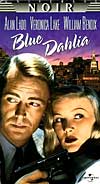
The popular noir couple were brought together again in George Marshall'south post-war criminal offense thriller The Blue Dahlia (1946), with an Oscar-nominated screenplay by Raymond Chandler (the only work he ever wrote straight for the screen). Alan Ladd portrayed returning war veteran Johnny Morrison who discovered that his married woman Helen (Doris Dowling) was unfaithful during his absence. When she turned up dead and he became the prime suspect, he was aided in the case by the mysterious Joyce Harwood (Lake) - the seductive ex-married woman of his married woman'south former lover.
Orson Welles and Film Noir:
Orson Welles' films accept pregnant noir features, such every bit in his expressionistically-filmed Citizen Kane (1941), with subjective camera angles, night shadowing and deep focus, and low-angled shots from talented cinematographer Gregg Toland. Welles' third picture for RKO, the war-time mystery Journeying Into Fear (1943), was ane in which he acted and co-directed (uncredited) - it was set in the exotic locale of Istanbul. The moving-picture show'south story was inspired past Eric Ambler'south spy thriller most the flying of an American arms engineer (Joseph Cotten) on a Black Ocean tramp steamer where he was threatened by Nazi agents intent on killing him.
The circuitous The Lady from Shanghai (1948) - with its plot (from Sherwood Rex'due south novel If I Should Die Before I Wake), told about a destructive honey triangle between Irish seaman Michael O'Hara (Welles himself), a manipulative Rita Hayworth every bit the platinum blonde-haired femme fatale Elsa (or Rosalie), and her husband Arthur Bannister (Everett Sloane). Its final sequence in a San Francisco "hall of mirrors" fun-business firm was symbolic and reflective of the shattered relationships between the characters, exemplified past a wounded O'Hara'south concluding words: "Perchance I'll live so long that I'll forget her. Maybe I'll die trying."
Welles' Mexican border-town B-moving picture classic Affect of Evil (1958) is generally considered the final flick in the classic cycle of motion picture noirs. It starred Charlton Heston as Vargas - a naive Mexican-American narcotics cop, Janet Leigh every bit his imperiled, honeymooning wife Susan, and Welles' own corrupt and corpulent local cop Hank Quinlan. The film also featured a improvement appearance by cigar-smoking bordello madam Marlene Dietrich, and a breathtaking opening credits sequence filmed in a single-take. Later, Welles' expressionistic noir and psychological drama The Trial (1962) was an adaptation of Franz Kafka's archetype novel, with Anthony Perkins as Joseph M - a man condemned for an unnamed crime in an unknown country.
More Definitive 40s Noirs:
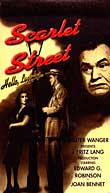 Early classic non-detective motion picture noirs included Fritz Lang'due south steamy and fatalistic Scarlet Street (1945) - one of the moodiest, blackest thrillers ever made, about a mild-mannered painter's (Edward M. Robinson) unpunished and unsuspected murder of an amoral femme fatale (Joan Bennett) later on she had led him to commit embezzlement, impersonated him in lodge to sell his paintings, and had been deceitful and cruel to him - causing him in a fit of acrimony to murder her with an ice-option. Director Abraham Polonsky'due south expressionistic, politically-subversive Forcefulness of Evil (1948) starred John Garfield every bit a corrupt mob attorney.
British manager Carol Reed's tense tale of treachery ready in post-war Vienna, The Third Human (1949), with the memorable character of blackness market racketeer Harry Lime (Orson Welles), ended with a climactic shootout in the urban center's noirish underground sewer. And the nightmarishly-night, rapid-paced and definitive D.O.A. (1949) from cinematographer-director Rudolph Mate - told the flashback story of lethally-poisoned and doomed protagonist Frank Bigelow (Edmond O'Brien), a victim of circumstance who announced in the opening: "I desire to study a murder - mine." [It was remade every bit D.O.A. (1988) with Dennis Quaid and One thousand thousand Ryan.]
Source: https://www.filmsite.org/filmnoir.html
0 Response to "Dark Film Mysteries Ii Film Noir Collectors Set Review"
Post a Comment